

Pickleball for beginners provides a welcoming entry point into the sport, offering essential guidance on rules, techniques, and equipment to help new players feel confident on the court. With a focus on foundational skills such as grip, footwork, and basic strokes, this resource empowers beginners to embrace the excitement of pickleball and embark on a fulfilling journey of skill development and enjoyment.
In this post, we’ll delve into the world of pickleball for beginners, providing invaluable insights and tips to support new players in mastering the fundamentals of the game. Whether picking up a paddle for the first time or transitioning from another sport, this guide aims to equip beginners with the knowledge and confidence to step onto the pickleball court with enthusiasm and readiness to learn.

Table of Contents
Affiliate Disclaimer
As an Amazon Associate I earn from qualifying purchases. As an affiliate, we also get commissions for purchases made through links on this website from other third parties.
Understanding Pickleball for Beginners
In grasping the essence of pickleball for beginners, you’ll uncover the rich history of Pickleball that stands out for its accessibility and rapidly growing popularity. Dive into the basics of the game and see how similar Pickleball is to tennis and other sports, such as badminton and ping pong.
History and Evolution
Pickleball’s inception dates back to 1965 on Bainbridge Island, near Seattle, Washington. It was created by three dads – Joel Pritchard, Bill Bell, and Barney McCallum – to entertain their children during the summer. From these humble beginnings, pickleball is now one of the fastest-growing sports in the United States. Today, it’s a celebrated activity across various age groups, combining elements of tennis, badminton, and ping pong into a unique and engaging sport.
The Basics of the Game
When starting with pickleball, it’s essential to understand its core components. The game is played on a Pickleball court that’s 20 feet wide by 44 feet long, divided into two by a net. Play begins with a serve that must be hit underhand and land in the opposite diagonal court. Points can only be scored by the serving side, and the first side reaching 11 points, leading by at least 2 points, wins the game. Key rules like the double bounce rule and the no-volley zone – or the kitchen, as it’s colloquially known – set pickleball apart from similar racket and paddle sports.
Pickleball vs Tennis, Badminton, and Ping Pong
Pickleball sets itself apart through several distinct aspects compared to tennis, badminton, and ping pong. It is played with a Pickleball paddle and a plastic Pickle ball with holes, as opposed to the stringed rackets and solid balls used in tennis and badminton or the small paddles and lightweight balls in ping pong. The court is smaller than a tennis court, which makes the game accessible and easier on the joints. The pace of pickleball is slower than badminton and faster than ping pong, offering a unique balance that emphasizes both strategy and agility.
Equipment Essentials
When starting in pickleball, the right equipment will significantly enhance your gameplay. Selecting gear that will complement your skill level and provide both comfort and performance is essential.
Choosing Your Pickleball Paddle
Your pickleball paddle is the most crucial piece of equipment, impacting your swing and control of the ball. Look for a paddle made of graphite or composite materials, as these balance power and control. Beginners often benefit from a lighter paddle, allowing for more agility and less arm fatigue during play.
Recommended Features:
- Weight: 6 to 8.5 ounces for easier handling.
- Material: Graphite or composite for durability and performance.
- Grip Size: Comfortable fit for your hand to prevent slippage and blisters.
Selecting Pickleball Balls
Pickleball balls are distinctive with their whiffle-like holes and come in indoor and outdoor varieties. Outdoor balls are heavier and have smaller, drilled holes, making them less wind-resistant. Indoor balls are softer and have larger holes, suited for smoother surfaces.
Ball Types:
- Outdoor: Harder, smaller holes, withstand rougher surfaces.
- Indoor: Softer, larger holes designed for gym floors.
Proper Footwear for the Court
Good pickleball shoes can significantly impact your game, offering stability and preventing injuries. Look for shoes with good cushioning, lateral support, and non-marking soles. Court shoes or tennis shoes are typically the best options.
What to Look For:
- Support: Lateral support for quick side-to-side movement.
- Cushioning: Enough to absorb impacts, but not so much that it reduces court feel.
- Soles: Non-marking with a good grip to handle the quick changes in direction.
The Pickleball Court
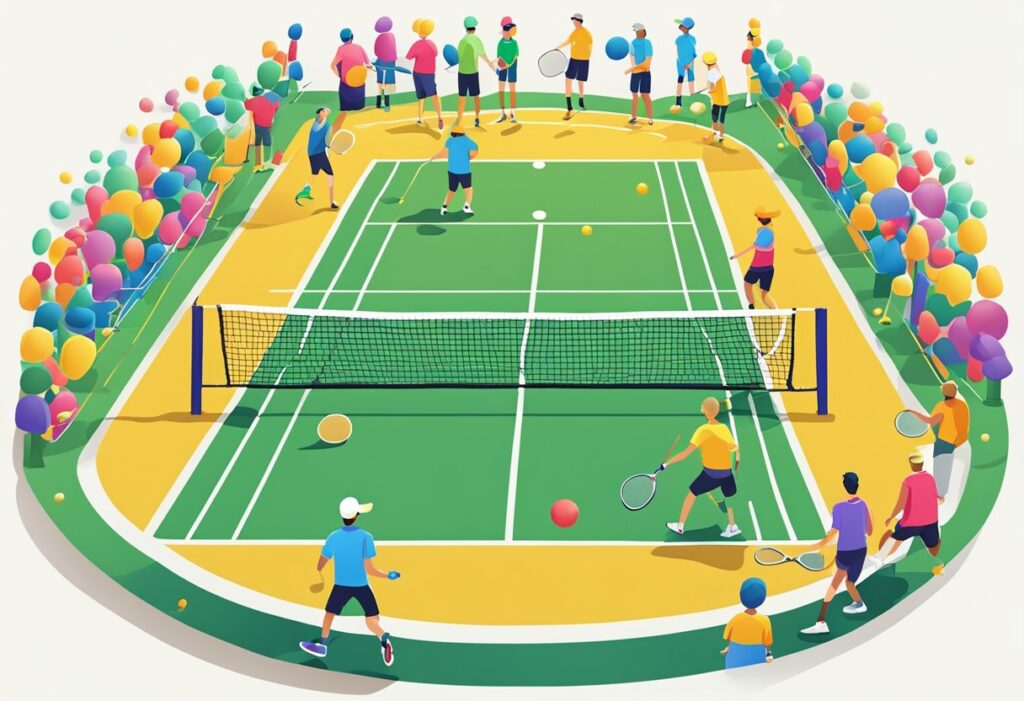
Being familiar with the pickleball court’s dimensions and distinctive zones is essential for beginners. A clear understanding of the playing area helps you navigate the game effectively.
Court Dimensions and Zones
- Court Size: Your pickleball court measures 20 feet in width and 44 feet in length for both singles and doubles. The court has a rectangular shape with clear lines marking the boundaries.
- Playing Areas:
- Baselines: The lines at the ends of the court, where you serve from.
- Sidelines: The lines that define the width of the court.
- Service Areas: Two boxes on either side where the ball must land during a serve.
Understanding the Non-Volley Zone (Kitchen)
The Non-Volley Zone, commonly called the kitchen, is a crucial area of the pickleball court spanning 7 feet from the net on both sides.
- Purpose: In this zone, you are prohibited from volleying the ball, meaning hitting it before it bounces.
- Net Height: The net splits the court in half, stands at 36 inches at the sidelines, and drops to 34 inches at the center.
Rules of the Game
Pickleball combines elements from tennis, badminton, and table tennis, and knowing the official Pickleball rules will help you enjoy the game and improve your play.
Scoring and Serving Rules
The score consists of three numbers: your score, your opponent’s score, and, if you’re serving, the number of serves your team has taken. When you serve, always start from the right side of the court and alternate each time a point is scored. The serve must be made underhand and below the waist, diagonally cross the court, and land in the opposite service box. You must serve behind the baseline without stepping onto the court until after you hit the serve. Winning a game requires reaching at least 11 points and leading by at least 2 points. For more details on how the serving sequence works within a game, you can review these basic Pickleball rules for beginners.
Faults and Penalties
A fault is a violation of the rules that ends the rally. Committing a fault will result in losing the rally or serving opportunity. Some common faults include hitting the ball out of bounds, not clearing the net, volleying in the non-volley zone, and violating the double bounce rule. The receiving side cannot return the serve before the ball has bounced once, and the serving side must let the ball bounce once before returning it; otherwise, it’s a fault. Stepping on the baseline while serving is also considered a fault. Visit this guide on faults and penalties for a more comprehensive understanding.
The Double Bounce Rule and Non-Volley Zone Rule
The double bounce rule requires that after the serve, the ball must bounce once before the receiving team hits it and again bounce once before the serving team returns it; thus, two bounces in total before volleys can occur. The non-volley zone or ‘kitchen’ rule prohibits players from volleying the ball—hitting it before it bounces—while standing in the non-volley zone, an area seven feet from the net on both sides. If you volley from the non-volley zone or step into it when volleying, it’s a fault. Refer to the Official Pickleball Rules for a visual representation of the court and non-volley zone.
Playing Pickleball
Pickleball is an accessible sport that combines elements of tennis, badminton, and table tennis. Whether playing singles or doubles, mastering the basic shots and applying strategic play is crucial to enjoying and improving the game.
Singles vs Doubles
Singles is a game of endurance and strategy where you cover the entire court yourself. Your movements and stamina play a key role, as you’ll need to strategize your shot placement to outmaneuver your opponent. In contrast, doubles require coordination with your partner and effective communication. The court is divided into shared responsibilities in doubles, reducing the range you must cover and introducing combined strategies like stacking or switching plays.
Mastering Basic Shots
There are several fundamental shots in pickleball that you should focus on:
- Forehand and Backhand Strokes: These are your primary shots, executed at either side of your body. A well-controlled forehand or backhand is essential for a powerful base game.
- The Serve: Starting the play with a deep serve to your opponent’s side can set the tone for the rally.
- The Dink: This soft shot is performed close to the net and designed to drop into the non-volley zone, or ‘kitchen’, making it difficult for the opponent to return with power.
- Groundstrokes: Hits after the ball bounces; groundstrokes are crucial for baseline play.
- Volleying: Striking the ball before it bounces, volleying requires agility and a knack for predicting the opponent’s play.
Strategies for GamePlay
Your pickleball strategy should focus on consistency, shot placement, and control. Instead of power, prioritize placing your shots where your opponent has to stretch to reach the ball. Employing shots like the dink to bring your opponent to the net, followed by a deep shot, can keep them off-balance. Lastly, always be ready to transition from defensive to offensive play.
As you explore these pickleball areas, remember to stay aware of your position, keep your shots varied, and aim to control the game’s pace. With practice and experience, you’ll understand how to play in singles or doubles effectively.
Developing Your Skills
To improve in pickleball, focus on mastering the fundamentals through regular, deliberate practice and paying attention to your movement and positioning on the court. Let’s break down these key areas to elevate your gameplay.
Using a playtime scheduler for pickleball is an excellent way to match yourself to opponents that will help you push your skill level to the next level.
Effective Practicing Techniques
For stepping up your game, engaging in purposeful practice is essential. Start with these techniques:
- Repetition: Build consistency by repeating keystrokes. Aim for precise shots rather than power to reduce unforced errors.
- Drill exercises: Incorporate drills that sharpen your skills, such as serving and volleying, to refine your technique.
Working on Footwork and Positioning
Your movement on the court is just as crucial as hitting the ball.
- Stance: Maintain a balanced stance with knees slightly bent. This ready position allows for quick lateral and forward movements.
- Proper footwear: Invest in quality footwear designed for court sports to prevent slips and provide support.
Addressing these aspects will strengthen your pickleball capabilities, providing a solid foundation to build upon as you gain more experience.
Joining the Community
Community participation can significantly enhance your playing experience when starting your pickleball journey. It provides ample opportunities to learn from seasoned players, develop new friendships, and elevate your game to competitive levels.
Finding Local Pickleball Communities
To kickstart your pickleball experience, find a community where beginners are welcome. USA Pickleball offers resources to help you locate groups near you where you can join other enthusiasts. These communities provide structured play sessions, social mixers, and the chance to observe more skilled athletes. You might start with the Beginner Pickleball 101 guide.
Playing with Friends and Family
Pickleball is a game best enjoyed with friends and family. Inviting them to play with you can foster a sense of camaraderie and shared improvement. Start simple with basic moves and drills, as detailed in the steps from Your First Steps into Pickleball.
Competing in Tournaments
Once you’re comfortable on the court, consider competing in tournaments. Even as a beginner, there are events tailored for newcomers. Participation can accelerate your development and even lead you to become a pickleball professional. To discover events suitable for beginners, consult resources like Pickleball for Beginners: Master the Basics & Start Playing Fast! and actively engage with your community to learn about upcoming competitions.
Advanced Topics
Moving beyond the fundamentals, you must refine your tactical and mental approach to improve your game. Below, the focus will be on developing a competitive mindset and mastering advanced techniques to set you apart from recreational play.
Developing a Competitive Mindset
To compete effectively in pickleball, your mindset is as important as your physical skills. Cultivating a competitive mindset involves staying focused and maintaining mental resilience during high-pressure situations. Recognize that errors are part of the game, but learning from mistakes is key to improving your performance. Keep your emotions in check and control the pace to disrupt your opponent’s strategy. Balancing aggression with patience is essential, especially when deciding when to employ power shots or when to drink.
Advanced Techniques and Tactics
As your skills progress, you should integrate advanced techniques and tactics that can help you control the court and dictate play.
- Dinking: Develop your soft game by mastering the dink—a strategic, gentle shot that lands in the opponent’s non-volley zone. Aim to make your dinks unattackable, requiring precision and control.
- Volleys: Improve your reaction time with volley drills, emphasizing quick hand speed and directional control to keep your opponents balanced.
- Third Shot Drop: Practice the third shot drop to transition from the baseline into the net. This shot is about placing the ball just over the net into the non-volley zone, allowing you to move forward with an advantage.
- Footwork and Positioning: Your footwork must be quick and efficient. Ensure you’re always able to hit the ball with balance and power.
Implement these pickleball tips and techniques consistently to elevate your game, aiming for precision over power until the opportunity arises to put away the shot.
Pickleball Culture and Etiquette
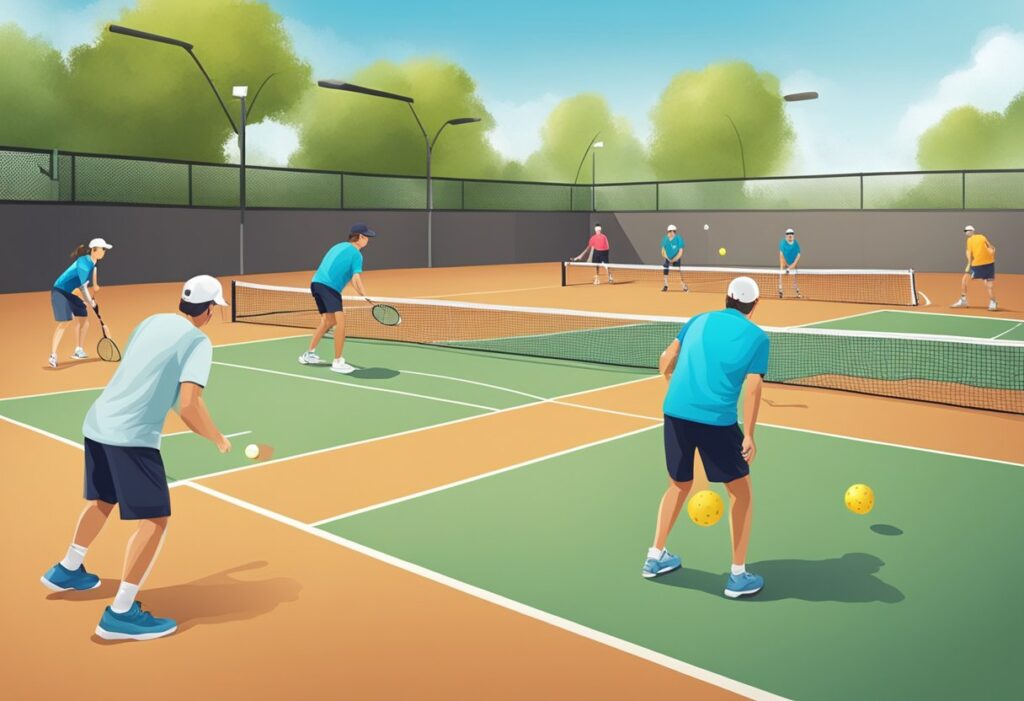
Pickleball isn’t just a sport; it’s an engaging social activity that brings individuals, families, and whole communities together. As you start your journey into pickleball games, immersing yourself in its culture and etiquette will enhance your experience and show respect for fellow players.
Key Aspects of Etiquette:
- Service: Serve underhand and behind the baseline. Wait until the receiver is ready.
- Score Calling: Always call the score out loud before serving: your score, your opponent’s score, and, if doubles, which server you are.
- Line Calls: Be honest and prompt with line calls. If in doubt, the benefit goes to your opponent.
- Paddle Taps: End games with a friendly paddle tap – a sign of good sportsmanship.
When you step onto the court, remember that pickleball is as much about fun and camaraderie as it is about competition. Here’s a quick guide to help you fit right in:
- Be Punctual: Arrive on time for games.
- Seek Knowledge: Learn the rules and strategies. A comprehensive guide to pickleball etiquette is a great starting point.
- Stay Positive: Encourage players with a positive affirmation. It maintains the fun atmosphere pickleball is known for.
- Support Others: Whether sharing tips with beginners or cheering for peers, uplift your pickleball companions.
- Take Turns: Especially in crowded courts, be considerate about court time. Play your game and rotate out to allow others to play.
- Keep Noise Down: Excessively loud celebrations can be distracting. Keep it moderate.
By following these standards, you’ll quickly become a valued member of the pickleball culture—a space that thrives on mutual respect and enjoyment.
Frequently Asked Questions
Navigating the basics of pickleball can be straightforward with the right information. Here are some commonly asked questions to set you on the right path.
What equipment is needed to start playing pickleball?
To begin playing pickleball, you’ll need a pickleball paddle, smaller than a tennis racquet but larger than a ping-pong paddle. You’ll also require a pickleball similar to a wiffle ball and appropriate shoes for court surfaces.
How do you keep score in pickleball for those just starting out?
Scoring in pickleball can be unique. The serving side can only score points, and games are usually played to 11, win by 2. The score should be called three numbers: the server’s score, the receiver’s score, and which server (1 or 2) is serving.
What are some fundamental strategies beginners should learn in pickleball?
Beginners should focus on mastering the serve and return, staying out of the ‘no-volley zone’ unless volleying, and learning the ‘soft game’, which involves gentle shots to maneuver opponents out of position, rather than powerful, smash hits.
Can you highlight the essential rules that pickleball newbies must know?
Key rules include understanding the double bounce rule, where the ball must bounce once on each side before volleys are allowed, and the no-volley zone rule, which prohibits volleying within 7 feet of the net to prevent spiking.
Where can beginners find pickleball lessons or courts nearby?
You can find local pickleball courts and professionals offering lessons catered to beginners. Many local community centers and sports facilities offer pickleball clinics and beginner-friendly sessions.
What skills should a beginner focus on developing to improve at pickleball?
As a beginner, I prioritize developing consistent serving, accurate shot placement, and understanding when to play defensively versus offensively. Building a strong foundation in the rules and strategies will significantly bolster your gameplay.


Leave a Reply