

Pickleball Courts vs Tennis Courts: Pickleball courts are notably smaller than tennis courts, with dimensions of 20 feet wide and 44 feet long for doubles play, as opposed to the larger size of tennis courts. Additionally, pickleball courts have a non-volley zone close to the net, a unique feature not found on tennis courts, and this distinction impacts the strategy and style of play in each sport.
In this post, we aim to highlight the key differences between pickleball courts and tennis courts, shedding light on the distinct dimensions, layout, and playing characteristics of each. By exploring the unique features of both court types, we provide valuable insights for players and enthusiasts seeking to understand the nuanced differences in size, design, and gameplay dynamics between pickleball and tennis.

Table of Contents
Affiliate Disclaimer
As an Amazon Associate I earn from qualifying purchases. As an affiliate, we also get commissions for purchases made through links on this website from other third parties.
Overview of Pickleball and Tennis
As a racquet sports enthusiast, you are likely aware that pickleball and tennis offer unique playing experiences.
While tennis has long been established as a globally popular sport, pickleball has emerged as a fast-growing contender in racquet sports.
Evolution of Racquet Sports
Pickleball originated in the mid-1960s as a family pastime in the United States, created by combining elements of tennis, badminton, and table tennis. It uses solid paddles of wood or composite materials to hit a perforated polymer ball over a net.
The sport has specific Pickleball rules and court dimensions, with a pickleball court measuring 20 feet in width and 44 feet in length.
In contrast, tennis dates back to the 19th century and evolved from earlier games in France. Modern tennis is played on a court that is 27 feet wide for singles and 36 feet wide for doubles, with a total length of 78 feet.
The game is recognized for its high-impact rallies, sophisticated techniques, and rich tournament heritage.
Popularity Trends
The popularity of tennis has been maintained through international tournaments such as Wimbledon and the US Open, which draw millions of viewers worldwide.
With its professional circuit and established clubs, tennis enjoys a strong following and infrastructure.
Pickleball Popularity, while newer, has seen a surge in interest due to its accessibility and social nature. It has gained many players in North America and the UK and is expanding elsewhere globally.
Communities have begun converting underutilized tennis courts to accommodate pickleball play, reflecting its increasing demand.
Court Specifications
When choosing between pickleball and tennis, understanding the court specifications is crucial. They differ in dimensions, lines, and areas, impacting how each game is played.
Pickleball Court Fundamentals
A pickleball court is a rectangular court 20 feet wide and 44 feet long, including lines. It’s divided into two equal halves by a net that stands 36 inches high at the ends and 34 inches high in the center.
The Pickleball court also features a non-volley zone, commonly known as the “kitchen,” extending 7 feet from the net on either side.
- Overall Court Size: 20 feet by 44 feet
- Net Height: 36 inches (sides), 34 inches (center)
- Non-Volley Zone: 7 feet from the net
Tennis Court Basics
A tennis court is larger than a Pickleball Court, measuring 78 feet long and, for singles matches, 27 feet wide. For doubles, the width extends to 36 feet.
The net height is similar to pickleball at 3 feet in the center. Tennis courts feature a baseline and service lines, with the center service line dividing the service boxes on each side.
- Overall Court Size:
- Singles: 78 feet by 27 feet
- Doubles: 78 feet by 36 feet
- Net Height: 3 feet (center)
Comparing Court Dimensions
When comparing court sizes, a tennis court is significantly longer and wider than a pickleball court.
Due to the size difference, you can fit approximately four pickleball courts on a single tennis court.
Understanding the dimensions and space required for each game can aid you in adapting a tennis court for pickleball or understanding how much space you’ll need for a new court.
- Pickleball vs. Tennis Court:
- Length: 44 feet vs. 78 feet
- Width: 20 feet vs. 27 feet (singles) or 36 feet (doubles)
Each court’s lines also play a unique role in their respective games, and they are suited to the sport’s specific needs, such as the non-volley zone in pickleball or the wider alleys for doubles in tennis.
The central location of the net and its height are critical, too, with the pickleball net being slightly higher at the ends.
Equipment Differences
The specific equipment used in racquet sports can greatly influence how the game is played. Your choice of paddles or rackets and the type of balls can vary widely between pickleball and tennis, each tailored to their respective games’ unique dynamics and rules.
Pickleball Paddles and Balls
Pickleball paddles are considerably different from tennis rackets. They are made from composite materials like graphite or aluminum and have a solid, flat surface without strings.
The average size of a Pickleball Paddle is about 8 inches wide by 15 inches long, allowing you to maneuver them quickly for the fast-paced nature of pickleball.
Regarding the Pickleball balls, pickleball uses lightweight, perforated plastic balls resembling a whiffle ball, which promotes a slower flight speed compared to tennis balls.
This affects how the game is played, as you’ll have more time to react and engage in strategic plays.
- Paddle Materials: Composite (e.g., graphite, aluminum)
- Paddle Size: ~8 inches wide by 15 inches long
- Ball Description: Lightweight, perforated plastic
- Gameplay Impact: Slower flight, strategic play
Tennis Rackets and Balls
Tennis rackets are larger than pickleball paddles and have a handle attached to a frame with an open hoop across a network of strings stretched tightly. These strings allow for a variety of shots and spins.
They are typically 27 inches long and can be made from carbon fiber, providing strength and lightness.
Tennis balls are heavier and covered in a fibrous felt, facilitating a faster speed and higher bounce when compared to pickleball balls.
You must be prepared for a more physically demanding game when playing tennis due to the equipment’s specifications.
- Racket Materials: Varied (e.g., carbon fiber)
- Racket Length: ~27 inches
- Ball Description: Heavy, fibrous felt covering
- Gameplay Impact: Faster speed, higher bounce
Playing Pickleball on a Tennis Court
Playing pickleball on a tennis court is feasible when dedicated pickleball facilities are unavailable. By understanding the conversion process and the modifications that can be made, you can enjoy pickleball without compromising the tennis court’s integrity.
Converting a Tennis Court
The first step to converting a tennis court to pickleball is understanding the dimensional differences. A tennis court is 60 feet wide and 120 feet long for doubles, whereas a pickleball court is 20 feet long and 44 feet long.
To align with pickleball regulations, you will need to mark the sidelines and baseline of a pickleball court within the confines of the tennis court.
Typically, this conversion is done by either painting permanent pickleball lines in contrast to the existing tennis lines or using temporary lines such as chalk or tape that will not damage the court surface.
- Sidelines: Paint or place temporary lines 20 feet from the center.
- Baseline: Mark the pickleball court’s baseline 22 feet from the net.
- Service Areas: Delineate service areas within the new baseline and sidelines.
Adding a portable pickleball net at the correct height (36 inches at the sidelines and 34 inches in the middle) is essential, as the tennis net is higher and has a different tension.
Temporary vs Permanent Modifications
When deciding between temporary or permanent modifications to facilitate playing pickleball on a tennis court, consider the frequency of play and the need to preserve the court for tennis.
Temporary Modifications
- Use chalk, tape, or temporary paint to create pickleball court lines.
- Employ a portable pickleball net system that can be easily set up and removed.
- Ensure any materials used for marking do not cause damage or leave residue on the court surface.
Permanent Modifications
- If pickleball is a long-term addition, paint permanent lines for pickleball, ideally in a color that is distinguishable yet not distracting from the tennis lines.
- Installing embedded sleeves for a pickleball net can provide a more durable and fixed playing experience, allowing for a quick net setup without altering the net height each time.
It’s important to account for the court’s surface when painting or making modifications to avoid any potential damage to the playing area.
Whether you opt for a temporary setup for occasional play or implement permanent solutions for frequent pickleball games, ensure that the integrity of the tennis court is preserved for both sports.
Gameplay and Rules
Pickleball and tennis have distinct gameplay and rule sets that cater to different strategies and player movements.
Understanding the nuances of scoring and the specific rules of each sport will enhance your playing experience, whether on a pickleball or tennis court.
Scoring and Game Structure
Pickleball:
- Scoring System: Games are typically played to 11 points and must be won by 2 points. You can only score a point while serving.
- Service: The serve is underhand and diagonal, starting at the right service square and alternating once a point is scored.
- Doubles vs. Singles: The rules remain consistent for singles and doubles, although positioning and strategies may vary.
- Net Height: The net is 36 inches at the sidelines and dips to 34 inches in the center.
Tennis:
- Scoring System: Games proceed through points of 15, 30, 40, and game. The first player typically wins a set to win six games with a margin of two.
- Service: The serve is overhand, beginning behind the baseline and landing diagonally opposite in the service box.
- Doubles vs. Singles: The court is more expansive using additional alley spaces, modifying service and return strategies in doubles.
- Net Height: The net stands 3.5 feet high at the posts and 3 feet at the center.
Rule Variations Between Sports
Court Surface: Tennis courts can be clay, grass, or hardcourt, affecting ball speed and bounce, while pickleball typically uses hardcourt surfaces that provide a consistent bounce.
Service Boxes: In tennis, the court is divided into two service areas on each side.
In pickleball, the area beyond the service boxes is the kitchen line, or non-volley zone, where volleys are prohibited.
Service Line: In tennis, players serve from behind the baseline into the opposite service box; in pickleball, serves must clear the non-volley zone.
When transitioning between sports, be mindful of the differences in the scoring system and the distinct rules, such as the service strategies and kitchen line in pickleball compared to the service boxes in tennis. Each sport offers unique advantages and challenges, and knowing their rules enhances your versatility as a player.
Spatial and Physical Considerations
When considering the transition between pickleball and tennis, your focus should be on the changes in court dimensions and the subsequent effects on safety and fitness levels.
Court Area Adaptations
Pickleball courts are significantly smaller than tennis courts.
You’ll observe that a pickleball court measures only 44 feet in length and 20 feet in width, whereas a tennis court spans 78 feet in length and 27 feet in width for singles matches, expanding to 36 feet in width for doubles matches.
This reduction in size means that you can fit multiple pickleball courts into the area of one tennis court, with four pickleball courts fitting into the same area used by a single tennis court.
When adapting a tennis court for pickleball play, you will need a measuring tape to accurately outline the smaller playing area.
If you’re considering marking a tennis court for pickleball, placing the temporary lines carefully is important, avoiding confusion with the existing tennis lines.
This clarity will ensure safety during gameplay as players rely on visual boundaries to move efficiently and safely across the court.
Safety and Fitness Impact
When playing pickleball on a tennis court, be aware of the surface material and its impact on joints due to the differences in game dynamics.
Tennis typically involves more lateral and backward movement, and with wider courts, there is a greater range of motion.
While ideal for the sport, the concrete or asphalt surfaces of tennis courts may exert excessive stress on your knees and ankles during a pickleball game, which involves more forward movement and shorter strides.
Each sport will influence Your fitness levels differently due to their court sizes and gameplay styles.
Pickleball, which is played on a smaller court, tends to involve less cardiovascular endurance and more short-burst agility when compared to tennis.
Head over to this post to learn the cardiovascular benefits of Pickleball
Therefore, when transitioning from tennis to pickleball or vice versa, it would be prudent to gradually adapt your fitness routine to accommodate these differences, thus minimizing the risk of injury and maximizing the effectiveness of your play.
Social and Community Aspects
The following sections summarize how Tennis vs Pickleball differ as community sports.
Tennis vs Pickleball as Community Sports
Tennis has long been a staple in many communities, offering a social setting for players of varied ages and skills.
With its traditional setup, a tennis facility often becomes a gathering point for social interactions, leagues, and tournaments.
Pickleball, a newcomer with a rapid growth trajectory, is known for its welcoming and inclusive community.
Pickleball courts, being smaller, facilitate closer communication between players, fostering a friendly atmosphere that’s well-suited to community-building activities.
Advantages of Multi-Use Courts
The versatility of rectangular courts is significant; converting a dedicated tennis court into a space where you can also play pickleball maximizes utility and brings diverse groups together.
This multi-use approach capitalizes on existing infrastructure to support different sports without additional space.
Your community benefits from the increased accessibility of sports facilities, meaning more people can engage in these healthy, social activities.
Padel vs Pickleball
When considering the racket sports of paddle tennis and pickleball, it’s important to understand their distinctive characteristics and the differences in court and equipment requirements.
Distinctive Features
Padel and Pickleball are different sports that have sometimes been confused due to their similar court sizes and equipment styles.
However, Padel is smaller than a traditional tennis court and uses a solid paddle to hit a depressurized tennis ball.
Meanwhile, pickleball combines elements of tennis, badminton, and table tennis using a perforated plastic ball and a composite or wooden paddle.
Court and Equipment Variances
- Court Dimensions: A standard pickleball court is 44 feet by 20 feet, slightly smaller in length than a paddle tennis court, which measures 50 feet by 20 feet. When comparing these to a tennis court, you’ll notice that a tennis court is significantly more prominent, with dimensions of 78 feet by 27 feet for singles matches.
Equipment: Pickleball paddles are smaller and lighter than those used in tennis, and they’re made of composite materials. Paddle tennis uses a solid paddle without strings and a depressurized tennis ball. The balls used in pickleball are made of hard plastic with holes through them, resembling a wiffle ball.
As you can see, while pickleball and paddle tennis share some similarities, such as using paddles and playing on a court denoted for racket sports, their equipment and court size reveal noticeable differences that define each sport’s unique gameplay experience.
Implementing Game Changeovers
When considering adapting existing sports facilities to accommodate new games, it’s important to have a comprehensive approach to court transition that respects the standards and requirements of the sports involved.
Facilitating Court Transitions for Multiple Sports
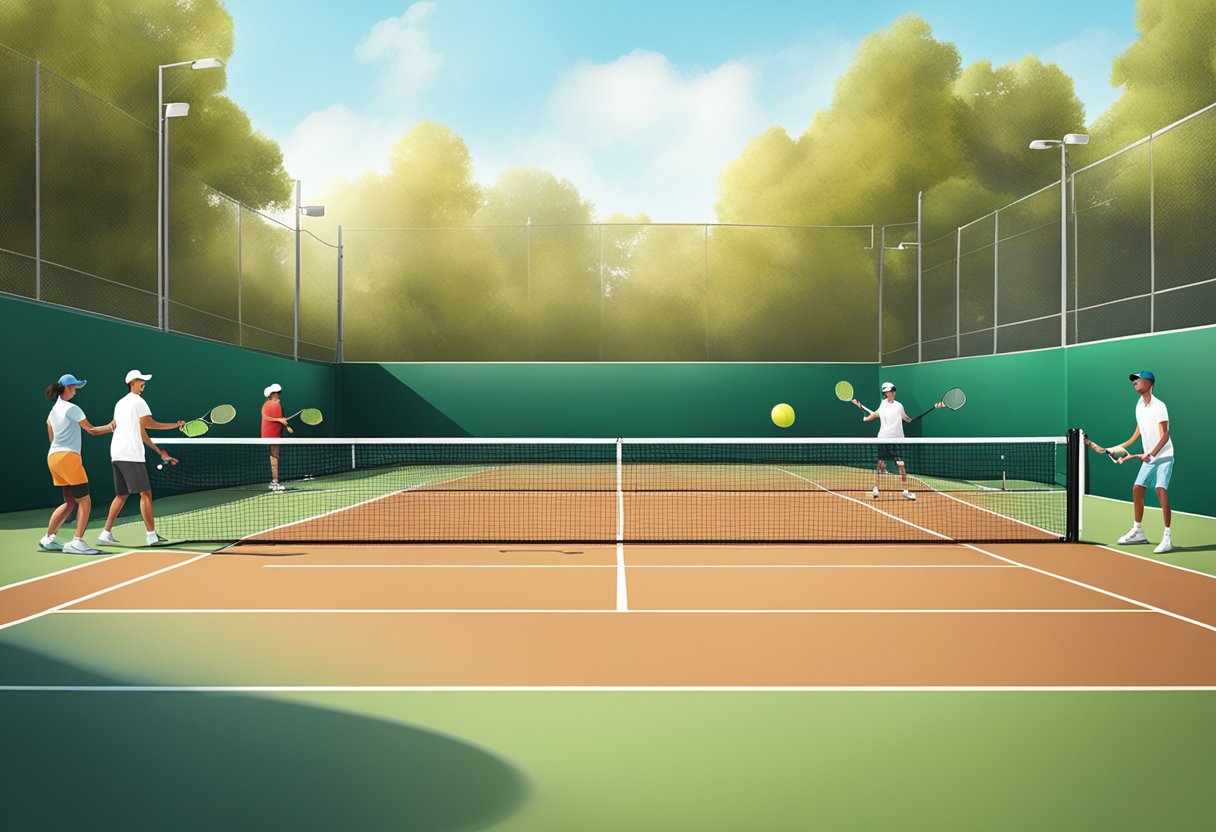
To convert a tennis court into a pickleball court, you must understand the similarities and differences between the two.
Tennis courts offer sufficient space as pickleball requires a smaller playing area – 20 by 44 feet for the court itself.
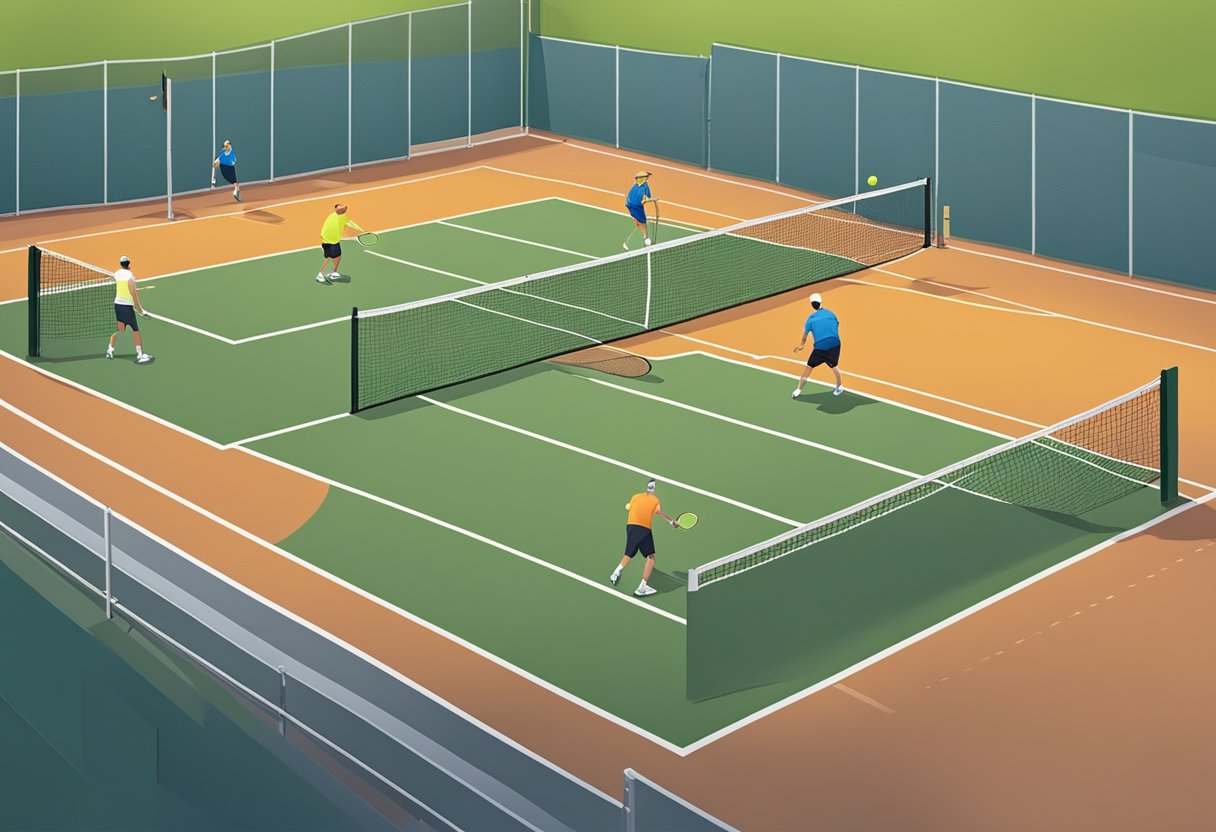
You can outline a pickleball court within an existing tennis court using temporary markers. This interim solution allows for a quick changeover without affecting the underlying tennis court surface and is ideal for multi-use facilities.
- Service lines: To avoid confusion, install permanent pickleball lines alongside the existing tennis lines using a different color.
- Portable nets: You can introduce a mobile net system that can be easily set up and removed as needed for pickleball. This allows for a swift transition between sports.
When implementing these transitions, ensure that the changes meet the regulatory standards of the sports in question. By doing so, you uphold the quality of play and maintain the integrity of both games.
Considerations for Court Owners
As a court owner, understanding the logistics involved in repurposing your tennis courts for pickleball is crucial. The demand for pickleball continues to rise, and accommodating this trend could benefit your facilities.
Costs and Practicality of Conversion
Tennis Courts to Pickleball Courts: Converting a single tennis court can yield up to four pickleball courts, maximizing the space for more players and potential revenue.
Your main expenses will be for the portable pickleball net systems, as these are slightly different in size and design from tennis nets.
- Nets: A standard pickleball net is 22 feet wide compared to a tennis net, which spans the entire 36 feet width of a tennis court. Installing a portable pickleball net is a practical solution that allows for quick setup and removal should you decide to alternate between sports.
- Surface: Consider the surface wear caused by the plastic ball with holes used in pickleball. It’s generally less damaging than tennis balls, but the added lines for pickleball courts could increase maintenance costs.
Cost Breakdown:
- Net systems: ~$100 – $250 each
- Line painting: ~$200 – $600 per court
- Maintenance: Variable based on existing court conditions
Remember, the decision to convert should be based not just on the initial setup costs but also on future maintenance and the potential increase in player traffic.
Pickleball vs. Padel: If contemplating between pickleball and paddle tennis, the conversion considerations are similar, but note that Padel uses a depressurized tennis ball and a lower net, which aligns closer with traditional tennis court specifications.
By carefully evaluating these factors, you can make an informed decision that aligns with your clientele’s needs and your facility’s operational goals.
Tactical Similarities and Differences
When comparing the strategies of pickleball and tennis, it is important to consider the distinctive characteristics that affect play, such as court dimensions and scoring systems.
Strategizing in Pickleball vs Tennis
Pickleball requires a unique approach to gameplay due to the smaller court size and the non-volley zone, or ‘kitchen’. This space, extending 7 feet from the net, is a no-volley zone, prohibiting players from playing volleys while standing within it.
It encourages a playstyle focused on patience and precise shot placement to avoid allowing opponents easy volleys from a close position.
In tennis, the larger court dimensions offer more space to cover, which shifts the emphasis to lateral movements and powerful baseline strokes.
Your tactical planning must also factor in serving strategies and the use of spin to exploit the court’s surface area, leveraging the scope for wider angles and longer rallies.
The scoring systems also underscore tactical disparities.
Pickleball uses a unique scoring system where you can only score points when serving, and games typically play to 11, win by 2.
With its Games, Sets, and Matches structure, tennis necessitates a more endurance-focused strategy, managing energy across potentially lengthy contests.
Overall, while both sports share a common thread in racket skills, your strategic execution must adapt to the varying scopes of play defined by different rules and courtyards.
Frequently Asked Questions
In these FAQs, you’ll find specific answers to common queries about the distinctions and playability between pickleball and paddle tennis and the necessary equipment and rules for each sport.
What are the key differences between pickleball and paddle tennis?
Pickleball is played with a perforated plastic ball and paddles on a badminton-sized court, while paddle tennis uses a depressurized tennis ball and solid paddles on a smaller court. The two sports also vary in terms of court surface and net height.
Can pickleball be played on a tennis court, and what modifications are necessary?
You can adapt a tennis court for pickleball, but you’ll need to lower the net to 34 inches in the center and mark the appropriate playing dimensions smaller than that of a tennis court.
How does the net height in pickleball compare to that of paddle tennis?
The net height in pickleball is 36 inches at the sidelines and 34 inches in the center, while paddle tennis courts feature a net consistently set at a height of 31 inches, facilitating a lower flight path for the ball.
What are the court dimensions for pickleball as opposed to paddle tennis courts?
A pickleball court measures 20 feet in width and 44 feet in length, while a regulation paddle tennis court is typically 20 feet wide and 50 feet long, offering slightly more play area lengthwise.
Are the paddles and balls used in pickleball the same as those used in paddle tennis?
No, pickleball uses composite or wooden paddles and a lightweight plastic ball. In contrast, paddle tennis employs solid paddles similar to platform tennis and a depressurized tennis ball, resulting in different gameplay dynamics.
What are the rule differences between pickleball and paddle tennis?
Pickleball and paddle tennis have differences in scoring, service rules, and fault rules. For example, in pickleball, the double bounce rule requires each team to play their first shot off of a bounce, which is not a rule in paddle tennis.


Leave a Reply